

-
1 defined below
Большой англо-русский и русско-английский словарь > defined below
-
2 defined below
-
3 defined below
Математика: нижеопределённый -
4 as defined below
Юридический термин: в соответствии с приводимым ниже определением, с учётом приведённого ниже определения, с учётом приводимого ниже определения, согласно приведенному ниже определению, согласно приводимому ниже определению, в соответствии с определением этого термина, приведенным ниже, в соответствии с приведённым ниже определением, как он определён ниже, определение дано ниже -
5 defined
1) определенный
2) заданный
3) осуществляемый
4) задаваемый
– be defined
– clearly defined
– completely defined
– defined below
– defined notion
– defined value
– everywhere defined
– finitely defined
– positive defined
incompletely defined function — не всюду определенная функция
-
6 below
1) ниже
2) внизу
3) снизу
– below normal
– bounded below
– defined below
– enumerated below
– from below
– mentioned below
– named below
– stated below
-
7 нижеопределенный
Большой англо-русский и русско-английский словарь > нижеопределенный
-
8 function
1) функция, действие || функционировать; действовать- essential functions - routine function - safety-related functions2) функциональное назначение; роль- circuit function - intrinsic function - metering function - primary function - robot function - planning function - service function - support function4) функциональный узел ( машины)5) матем. функциональная зависимость, функция- absolutely additive function - absolutely bounded function - absolutely continuous function - absolutely integrable function - absolutely monotone function - absolutely summable function - absolutely symmetric function - almost complex function - almost continuous function - almost convex function - almost everywhere defined function - almost everywhere finite function - almost invariant function - almost periodic function - almost recursive function - almost separably-valued function - almost separating function - almost universal function - analytically independent function - analytically representable function - approximately differentiable function - asymptotically differentiable function - asymptotically finite function - asymptotically uniformly optimal function - bounded below function - cellwise continuous function - circumferentially mean p-valent function - comparison function - complementary error function - complete analytic function - completely additive function - completely computable function - completely monotone function - completely multiplicative function - completely productive function - completely subadditive function - completely symmetrical function - completely undefined function - complex hyperbolic function - conditional risk function - countably multiplicative function - countably valued function - covariant function - cumulative distribution function - cumulative frequency function - deficiency function - double limit function - doubly periodic function - doubly recursive function - effectively computable function - effectively constant function - effectively decidable function - effectively variable function - elementarily symmetric function - entire function of maximum type - entire function of mean type - entire function of potential type - entire function of zero type - entire rational function - essentially increasing function - essentially integrable function - essentially real function - essentially smooth function - everywhere differentiable function - everywhere smooth function - expansible function - explicitly definable function - exponentially convex function - exponentially decreasing function - exponentially increasing function - exponentially multiplicative function - exponentially vanishing function - finitely mean valent function - finitely measurable function - function of appropriate behavior - function of bounded characteristic - function of bounded type - function of bounded variation - function of complex variable - function of exponential type - function of finite genus - function of finite variation - function of fractional order - function of infinite type - function of integral order - function of maximal type - function of minimal type - function of mixed variables - function of normal type - function of number theory - function of one variable - function of rapid descent - function of rapid growth - function of real variable - general universal function - geometric carrier function - implicitly definable function - incomplete dibeta function - incomplete gamma function - incomplete tribeta function - incompletely defined function - inductively defined function - inductively integrable function - infinitely divisible function - infinitely many-valued function - integral logarithmic function - inverse trigonometric function - inverted beta function - iterative function - joint correlation function - joint density function - linearly separable function - locally bounded function - locally constant function - locally holomorphic function - locally homogeneous function - locally integrable function - locally negligible function - locally regular function - locally summable function - logarithmic generating function - logarithmic integral function - logarithmically infinite function - logarithmically plurisubharmonic function - logarithmically subharmonic function - lower semicontinuous function - monotone non-decreasing function - monotone non-increasing function - multiply periodic function - multiply recursive function - negative definite function - negative infinite function - nontangentially bounded function - normalized function - normed function - nowhere continuous function - nowhere differentiable function - nowhere monotonic function - n-times differentiable function - n-tuply periodic function - numeralwise expressible function - numeralwise representable function - numerical function - numerically valued function - oblate spheroidal function - operating characteristic function - optimal policy function - parametrically definable function - partially symmetric function - piecewise constant function - piecewise continuously differentiable function - piecewise linear function - piecewise monotonic function - piecewise polynomial function - piecewise quadratic function - piecewise regular function - piecewise smooth function - pointwise approximated function - positive homogeneous function - positive infinite function - positive monotone function - positive monotonic function - positive semidefinite function - potentially calculable function - potentially recursive function - power series function - probability generating function - quadratically summable function - rapidly damped function - rapidly decreasing function - rapidly oscillatory function - recursively continuous function - recursively convergent function - recursively defined function - recursively differentiable function - recursively divergent function - recursively extensible function - relative distribution function - relative frequency function - representing function - reproducing kernel function - residual function - residue function - scalarwise integrable function - scalarwise measurable function - sectionally smooth function - simply periodic function - singly recursive function - slowly increasing function - slowly oscillating function - slowly varying function - smoothly varying function - solid spherical harmonic function - solid zonal harmonic function - steadily increasing function - stopped random function - strictly convex function - strictly decreasing function - strictly increasing function - strictly integrable function - strictly monotone function - strongly differentiable function - strongly holomorphic function - strongly integrable function - strongly measurable function - strongly plurisubharmonic function - totally additive function - totally continuous function - totally measurable function - totally multiplicative function - totally positive function - triangular function - uniformly best decision function - uniformly bounded function - uniformly definable function - uniformly differentiable function - uniformly homotopic function - uniformly integrable function - uniformly limited function - uniformly measurable function - uniformly smooth function - unit step function - unitary divisor function - upper measurable function - upper semicontinuous function - weakly analytic function - weakly continuous function - weakly differentiable function - weakly holomorphic function - weakly measurable function - weakly singular function - weighted random functiondomain of a function — область определения функции, область изменения независимой переменной
-
9 bidder
сущ.1) эк. участник торгов, покупатель, покупщик, претендента) (лицо, делающее предложение, особенно на аукционе)A mock auction is defined by Sect. 1 (3) of this Act as a sale of goods by way of competitive bidding if the goods are sold at less than the highest bid, or part of the price is repaid to the bidder. — Фиктивный аукцион определен в разделе 1 (3) настоящего закона как продажа товаров путем конкурентных торгов, когда товары продаются по цене, меньшей, чем высшая из предложенных цен, или если часть цены возвращена участнику торгов.
See:absentee bidder, below cost bidder, best bidder, bybidder, by-bidder, highest bidder, proxy bidder, shill bidder, underbidder, bidders list, auction, reverse auction, bid scheduleб) (фирма, ведущая переговоры о заключении подряда на поставки)2) фин., упр. (компания-)покупатель* (компания, выступающая инициатором поглощения)a possible bidder for Dutch production company — возможный участник торгов по голландской производственной фирме
Syn:buyer 1) в)See:
* * *
1) покупатель; лицо, предлагающее цену; 2) участник торгов.* * ** * *Покупатель (участник торгов), заявитель; участник конкурса; кандидат; соискатель. Компания или частное лицо, которая (ое) желает купить компанию или ценную бумагу . Инвестиционная деятельность .* * *Международные перевозки/Таможенное правофирма, ведущая переговоры о заключении подряда на поставки (грузоперевозки)-----Ценные бумаги/Биржевая деятельностьлицо, выступающее на торгах, покупщик -
10 geoid undulation
geoid undulation; GUNDThe distance of the geoid above (positive) or below (negative) the mathematical reference ellipsoid.Note.— In respect to the World Geodetic System — 1984 (WGS-84) defined ellipsoid, the difference between the WGS-84 ellipsoidal height and orthometric height represents WGS-84 geoid undulation.(AN 4; AN 14/I; AN 14/II; AN 15; PANS-OPS/II)Official definition added to: AN 4 by Amdt 51 (05/11/1998), AN 14/I & 14/II by Amdt 2 (1997), AN 15 by Amdt 29 (06/11/1997).волна геоида; GUNDРасстояние (положительное значение или отрицательное значение) между поверхностью геоида и поверхностью математически определённого референц-эллипсоида.Примечание. В отношении эллипсоида, определённого во Всемирной геодезической системе — 1984 (WGS-84), разница между высотой относительно эллипсоида WGS-84 и ортометрической высотой геоида представляет собой волну геоида.International Civil Aviation Vocabulary (English-Russian) > geoid undulation
-
11 GUND
geoid undulation; GUNDThe distance of the geoid above (positive) or below (negative) the mathematical reference ellipsoid.Note.— In respect to the World Geodetic System — 1984 (WGS-84) defined ellipsoid, the difference between the WGS-84 ellipsoidal height and orthometric height represents WGS-84 geoid undulation.(AN 4; AN 14/I; AN 14/II; AN 15; PANS-OPS/II)Official definition added to: AN 4 by Amdt 51 (05/11/1998), AN 14/I & 14/II by Amdt 2 (1997), AN 15 by Amdt 29 (06/11/1997).волна геоида; GUNDРасстояние (положительное значение или отрицательное значение) между поверхностью геоида и поверхностью математически определённого референц-эллипсоида.Примечание. В отношении эллипсоида, определённого во Всемирной геодезической системе — 1984 (WGS-84), разница между высотой относительно эллипсоида WGS-84 и ортометрической высотой геоида представляет собой волну геоида.International Civil Aviation Vocabulary (English-Russian) > GUND
-
12 reference humidity
The relationship between temperature and reference humidity is defined as follows:— at temperatures at and below ISA, 80 per cent relative humidity,— at temperatures at and above ISA + 28°C, 34 per cent relative humidity,— at temperatures between ISA and ISA + 28°C, the relative humidity varies linearly between the humidity specified for those temperatures.(AN 6/I)Cooтнoшeниe мeжду тeмпeрaтурoй и рaсчётнoй влaжнoстью oпрeдeляeтся слeдующим oбрaзoм:— при температурах, соответствующих температуре МСА и ниже её, относительная влажность составляет 80%;— при тeмпeрaтурaх, сooтвeтствующих тeмпeрaтурe MCA + 28°C и вышe, oтнoситeльнaя влaжнoсть сoстaвляeт 34%;— при тeмпeрaтурaх в диaпaзoнe мeжду тeмпeрaтурoй MCA и тeмпeрaтурoй MCA + 28°C oтнoситeльнaя влaжнoсть измeняeтся пo линeйнoму зaкoну в прeдeлaх знaчeний влaжнoсти для укaзaнных тeмпeрaтур.International Civil Aviation Vocabulary (English-Russian) > reference humidity
-
13 operator
1) диспетчер2) владелец ( оборудования)3) машинист4) оператор машины или системы6) матем. оператор- almost periodic operator - amateur radio operator - asymptotically polylinear operator - bounded below operator - completely invertible operator - double stochastic operator - formally hypoelliptic operator - formally self-adjoint operator - formally symmetric operator - internal operator - isotonic operator - left shift operator - locally algebraic operator - locally measurable operator - negative semidefinite operator - normally resolvable operator - partial recursive operator - partially hypoelliptic operator - partially isometric operator - positive definite operator - positive semidefinite operator - properly orthogonal operator - relatively degenerate operator - relatively invertible operator - relatively regular operator - selective operator - skew adjoint operator - skew self-adjoint operator - uniformly strongly elliptic operator - weakly separable operator -
14 courant admissible, m
(длительный) допустимый ток
Максимальное значение электрического тока, который может протекать длительно по проводнику, устройству или аппарату при определенных условиях без превышения определенного значения их температуры в установившемся режиме
[ ГОСТ Р МЭК 60050-826-2009]
Этот ток обозначают IZ
[ ГОСТ Р 50571. 1-2009 ( МЭК 60364-1: 2005)]EN
(continuous) current-carrying capacity
ampacity (US)
maximum value of electric current which can be carried continuously by a conductor, a device or an apparatus, under specified conditions without its steady-state temperature exceeding a specified value
[IEV number 826-11-13]
ampacity
The current in amperes that a conductor can carry continuously under the conditions of use without exceeding its temperature rating.
[National Electrical Cod]FR
courant (permanent) admissible, m
valeur maximale du courant électrique qui peut parcourir en permanence, un conducteur, un dispositif ou un appareil, sans que sa température de régime permanent, dans des conditions données, soit supérieure à la valeur spécifiée
[IEV number 826-11-13]Ampacity, the term is defined as the maximum amount of current a cable can carry before sustaining immediate or progressive deterioration. Also described as current rating or current-carrying capacity, is the RMS electric current which a device can continuously carry while remaining within its temperature rating. The ampacity of a cable depends on:
- its insulation temperature rating;
- conductor electrical properties for current;
- frequency, in the case of alternating currents;
- ability to dissipate heat, which depends on cable geometry and its surroundings;
- ambient temperature.
Electric wires have some resistance, and electric current flowing through them causes voltage drop and power dissipation, which heats the cable. Copper or aluminum can conduct a large amount of current before melting, but long before the conductors melt, their insulation would be damaged by the heat.
The ampacity for a power cable is thus based on physical and electrical properties of the material & construction of the conductor and of its insulation, ambient temperature, and environmental conditions adjacent to the cable. Having a large overall surface area may dissipate heat well if the environment can absorb the heat.
In a long run of cable, different conditions govern, and installation regulations normally specify that the most severe condition along the run governs the cable's rating. Cables run in wet or oily locations may carry a lower temperature rating than in a dry installation. Derating is necessary for multiple circuits in close proximity. When multiple cables are near, each contributes heat to the others and diminishes the amount of cooling air that can flow past the individual cables. The overall ampacity of the insulated conductors in a bundle of more than 3 must be derated, whether in a raceway or cable. Usually the de-rating factor is tabulated in a nation's wiring regulations.
Depending on the type of insulating material, common maximum allowable temperatures at the surface of the conductor are 60, 75 and 90 degrees Celsius, often with an ambient air temperature of 30°C. In the U.S., 105°C is allowed with ambient of 40°C, for larger power cables, especially those operating at more than 2 kV. Likewise, specific insulations are rated 150, 200 or 250°C.
The allowed current in cables generally needs to be decreased (derated) when the cable is covered with fireproofing material.
For example, the United States National Electric Code, Table 310-16, specifies that up to three 8 AWG copper wires having a common insulating material (THWN) in a raceway, cable, or direct burial has an ampacity of 50 A when the ambient air is 30°C, the conductor surface temperature allowed to be 75°C. A single insulated conductor in air has 70 A rating.
Ampacity rating is normally for continuous current, and short periods of overcurrent occur without harm in most cabling systems. The acceptable magnitude and duration of overcurrent is a more complex topic than ampacity.
When designing an electrical system, one will normally need to know the current rating for the following:- Wires
- Printed Circuit Board traces, where included
- Fuses
- Circuit breakers
- All or nearly all components used
Some devices are limited by power rating, and when this power rating occurs below their current limit, it is not necessary to know the current limit to design a system. A common example of this is lightbulb holders.
[http://en.wikipedia.org/wiki/Ampacity]
Тематики
- электротехника, основные понятия
Синонимы
EN
DE
- Dauerstrombelastbarkeit, f
- Strombelastbarkeit, f
FR
- courant admissible, m
- courant permanent admissible, m
Франко-русский словарь нормативно-технической терминологии > courant admissible, m
-
15 courant permanent admissible, m
(длительный) допустимый ток
Максимальное значение электрического тока, который может протекать длительно по проводнику, устройству или аппарату при определенных условиях без превышения определенного значения их температуры в установившемся режиме
[ ГОСТ Р МЭК 60050-826-2009]
Этот ток обозначают IZ
[ ГОСТ Р 50571. 1-2009 ( МЭК 60364-1: 2005)]EN
(continuous) current-carrying capacity
ampacity (US)
maximum value of electric current which can be carried continuously by a conductor, a device or an apparatus, under specified conditions without its steady-state temperature exceeding a specified value
[IEV number 826-11-13]
ampacity
The current in amperes that a conductor can carry continuously under the conditions of use without exceeding its temperature rating.
[National Electrical Cod]FR
courant (permanent) admissible, m
valeur maximale du courant électrique qui peut parcourir en permanence, un conducteur, un dispositif ou un appareil, sans que sa température de régime permanent, dans des conditions données, soit supérieure à la valeur spécifiée
[IEV number 826-11-13]Ampacity, the term is defined as the maximum amount of current a cable can carry before sustaining immediate or progressive deterioration. Also described as current rating or current-carrying capacity, is the RMS electric current which a device can continuously carry while remaining within its temperature rating. The ampacity of a cable depends on:
- its insulation temperature rating;
- conductor electrical properties for current;
- frequency, in the case of alternating currents;
- ability to dissipate heat, which depends on cable geometry and its surroundings;
- ambient temperature.
Electric wires have some resistance, and electric current flowing through them causes voltage drop and power dissipation, which heats the cable. Copper or aluminum can conduct a large amount of current before melting, but long before the conductors melt, their insulation would be damaged by the heat.
The ampacity for a power cable is thus based on physical and electrical properties of the material & construction of the conductor and of its insulation, ambient temperature, and environmental conditions adjacent to the cable. Having a large overall surface area may dissipate heat well if the environment can absorb the heat.
In a long run of cable, different conditions govern, and installation regulations normally specify that the most severe condition along the run governs the cable's rating. Cables run in wet or oily locations may carry a lower temperature rating than in a dry installation. Derating is necessary for multiple circuits in close proximity. When multiple cables are near, each contributes heat to the others and diminishes the amount of cooling air that can flow past the individual cables. The overall ampacity of the insulated conductors in a bundle of more than 3 must be derated, whether in a raceway or cable. Usually the de-rating factor is tabulated in a nation's wiring regulations.
Depending on the type of insulating material, common maximum allowable temperatures at the surface of the conductor are 60, 75 and 90 degrees Celsius, often with an ambient air temperature of 30°C. In the U.S., 105°C is allowed with ambient of 40°C, for larger power cables, especially those operating at more than 2 kV. Likewise, specific insulations are rated 150, 200 or 250°C.
The allowed current in cables generally needs to be decreased (derated) when the cable is covered with fireproofing material.
For example, the United States National Electric Code, Table 310-16, specifies that up to three 8 AWG copper wires having a common insulating material (THWN) in a raceway, cable, or direct burial has an ampacity of 50 A when the ambient air is 30°C, the conductor surface temperature allowed to be 75°C. A single insulated conductor in air has 70 A rating.
Ampacity rating is normally for continuous current, and short periods of overcurrent occur without harm in most cabling systems. The acceptable magnitude and duration of overcurrent is a more complex topic than ampacity.
When designing an electrical system, one will normally need to know the current rating for the following:- Wires
- Printed Circuit Board traces, where included
- Fuses
- Circuit breakers
- All or nearly all components used
Some devices are limited by power rating, and when this power rating occurs below their current limit, it is not necessary to know the current limit to design a system. A common example of this is lightbulb holders.
[http://en.wikipedia.org/wiki/Ampacity]
Тематики
- электротехника, основные понятия
Синонимы
EN
DE
- Dauerstrombelastbarkeit, f
- Strombelastbarkeit, f
FR
- courant admissible, m
- courant permanent admissible, m
Франко-русский словарь нормативно-технической терминологии > courant permanent admissible, m
-
16 Dauerstrombelastbarkeit, f
(длительный) допустимый ток
Максимальное значение электрического тока, который может протекать длительно по проводнику, устройству или аппарату при определенных условиях без превышения определенного значения их температуры в установившемся режиме
[ ГОСТ Р МЭК 60050-826-2009]
Этот ток обозначают IZ
[ ГОСТ Р 50571. 1-2009 ( МЭК 60364-1: 2005)]EN
(continuous) current-carrying capacity
ampacity (US)
maximum value of electric current which can be carried continuously by a conductor, a device or an apparatus, under specified conditions without its steady-state temperature exceeding a specified value
[IEV number 826-11-13]
ampacity
The current in amperes that a conductor can carry continuously under the conditions of use without exceeding its temperature rating.
[National Electrical Cod]FR
courant (permanent) admissible, m
valeur maximale du courant électrique qui peut parcourir en permanence, un conducteur, un dispositif ou un appareil, sans que sa température de régime permanent, dans des conditions données, soit supérieure à la valeur spécifiée
[IEV number 826-11-13]Ampacity, the term is defined as the maximum amount of current a cable can carry before sustaining immediate or progressive deterioration. Also described as current rating or current-carrying capacity, is the RMS electric current which a device can continuously carry while remaining within its temperature rating. The ampacity of a cable depends on:
- its insulation temperature rating;
- conductor electrical properties for current;
- frequency, in the case of alternating currents;
- ability to dissipate heat, which depends on cable geometry and its surroundings;
- ambient temperature.
Electric wires have some resistance, and electric current flowing through them causes voltage drop and power dissipation, which heats the cable. Copper or aluminum can conduct a large amount of current before melting, but long before the conductors melt, their insulation would be damaged by the heat.
The ampacity for a power cable is thus based on physical and electrical properties of the material & construction of the conductor and of its insulation, ambient temperature, and environmental conditions adjacent to the cable. Having a large overall surface area may dissipate heat well if the environment can absorb the heat.
In a long run of cable, different conditions govern, and installation regulations normally specify that the most severe condition along the run governs the cable's rating. Cables run in wet or oily locations may carry a lower temperature rating than in a dry installation. Derating is necessary for multiple circuits in close proximity. When multiple cables are near, each contributes heat to the others and diminishes the amount of cooling air that can flow past the individual cables. The overall ampacity of the insulated conductors in a bundle of more than 3 must be derated, whether in a raceway or cable. Usually the de-rating factor is tabulated in a nation's wiring regulations.
Depending on the type of insulating material, common maximum allowable temperatures at the surface of the conductor are 60, 75 and 90 degrees Celsius, often with an ambient air temperature of 30°C. In the U.S., 105°C is allowed with ambient of 40°C, for larger power cables, especially those operating at more than 2 kV. Likewise, specific insulations are rated 150, 200 or 250°C.
The allowed current in cables generally needs to be decreased (derated) when the cable is covered with fireproofing material.
For example, the United States National Electric Code, Table 310-16, specifies that up to three 8 AWG copper wires having a common insulating material (THWN) in a raceway, cable, or direct burial has an ampacity of 50 A when the ambient air is 30°C, the conductor surface temperature allowed to be 75°C. A single insulated conductor in air has 70 A rating.
Ampacity rating is normally for continuous current, and short periods of overcurrent occur without harm in most cabling systems. The acceptable magnitude and duration of overcurrent is a more complex topic than ampacity.
When designing an electrical system, one will normally need to know the current rating for the following:- Wires
- Printed Circuit Board traces, where included
- Fuses
- Circuit breakers
- All or nearly all components used
Some devices are limited by power rating, and when this power rating occurs below their current limit, it is not necessary to know the current limit to design a system. A common example of this is lightbulb holders.
[http://en.wikipedia.org/wiki/Ampacity]
Тематики
- электротехника, основные понятия
Синонимы
EN
DE
- Dauerstrombelastbarkeit, f
- Strombelastbarkeit, f
FR
- courant admissible, m
- courant permanent admissible, m
Немецко-русский словарь нормативно-технической терминологии > Dauerstrombelastbarkeit, f
-
17 Strombelastbarkeit, f
(длительный) допустимый ток
Максимальное значение электрического тока, который может протекать длительно по проводнику, устройству или аппарату при определенных условиях без превышения определенного значения их температуры в установившемся режиме
[ ГОСТ Р МЭК 60050-826-2009]
Этот ток обозначают IZ
[ ГОСТ Р 50571. 1-2009 ( МЭК 60364-1: 2005)]EN
(continuous) current-carrying capacity
ampacity (US)
maximum value of electric current which can be carried continuously by a conductor, a device or an apparatus, under specified conditions without its steady-state temperature exceeding a specified value
[IEV number 826-11-13]
ampacity
The current in amperes that a conductor can carry continuously under the conditions of use without exceeding its temperature rating.
[National Electrical Cod]FR
courant (permanent) admissible, m
valeur maximale du courant électrique qui peut parcourir en permanence, un conducteur, un dispositif ou un appareil, sans que sa température de régime permanent, dans des conditions données, soit supérieure à la valeur spécifiée
[IEV number 826-11-13]Ampacity, the term is defined as the maximum amount of current a cable can carry before sustaining immediate or progressive deterioration. Also described as current rating or current-carrying capacity, is the RMS electric current which a device can continuously carry while remaining within its temperature rating. The ampacity of a cable depends on:
- its insulation temperature rating;
- conductor electrical properties for current;
- frequency, in the case of alternating currents;
- ability to dissipate heat, which depends on cable geometry and its surroundings;
- ambient temperature.
Electric wires have some resistance, and electric current flowing through them causes voltage drop and power dissipation, which heats the cable. Copper or aluminum can conduct a large amount of current before melting, but long before the conductors melt, their insulation would be damaged by the heat.
The ampacity for a power cable is thus based on physical and electrical properties of the material & construction of the conductor and of its insulation, ambient temperature, and environmental conditions adjacent to the cable. Having a large overall surface area may dissipate heat well if the environment can absorb the heat.
In a long run of cable, different conditions govern, and installation regulations normally specify that the most severe condition along the run governs the cable's rating. Cables run in wet or oily locations may carry a lower temperature rating than in a dry installation. Derating is necessary for multiple circuits in close proximity. When multiple cables are near, each contributes heat to the others and diminishes the amount of cooling air that can flow past the individual cables. The overall ampacity of the insulated conductors in a bundle of more than 3 must be derated, whether in a raceway or cable. Usually the de-rating factor is tabulated in a nation's wiring regulations.
Depending on the type of insulating material, common maximum allowable temperatures at the surface of the conductor are 60, 75 and 90 degrees Celsius, often with an ambient air temperature of 30°C. In the U.S., 105°C is allowed with ambient of 40°C, for larger power cables, especially those operating at more than 2 kV. Likewise, specific insulations are rated 150, 200 or 250°C.
The allowed current in cables generally needs to be decreased (derated) when the cable is covered with fireproofing material.
For example, the United States National Electric Code, Table 310-16, specifies that up to three 8 AWG copper wires having a common insulating material (THWN) in a raceway, cable, or direct burial has an ampacity of 50 A when the ambient air is 30°C, the conductor surface temperature allowed to be 75°C. A single insulated conductor in air has 70 A rating.
Ampacity rating is normally for continuous current, and short periods of overcurrent occur without harm in most cabling systems. The acceptable magnitude and duration of overcurrent is a more complex topic than ampacity.
When designing an electrical system, one will normally need to know the current rating for the following:- Wires
- Printed Circuit Board traces, where included
- Fuses
- Circuit breakers
- All or nearly all components used
Some devices are limited by power rating, and when this power rating occurs below their current limit, it is not necessary to know the current limit to design a system. A common example of this is lightbulb holders.
[http://en.wikipedia.org/wiki/Ampacity]
Тематики
- электротехника, основные понятия
Синонимы
EN
DE
- Dauerstrombelastbarkeit, f
- Strombelastbarkeit, f
FR
- courant admissible, m
- courant permanent admissible, m
Немецко-русский словарь нормативно-технической терминологии > Strombelastbarkeit, f
-
18 bay
- ячейка распределительного устройства
- штатив
- узел (в дереве схемы)
- секция грузового отсека транспортного самолета
- секция (часть здания)
- провал (на кривой)
- присоединение (в электроэнергетике)
- погрузо-разгрузочная площадка
- панель фермы
- отсек (в строительстве)
- отсек (в компьютере)
- отсек
- блок-секция
- аппарат
блок-секция
Объёмно-пространственный элемент здания, независимый в функциональном отношении, который может использоваться как в сочетании с другими элементами здания, так и самостоятельно
[СНиП I-2]
[Терминологический словарь по строительству на 12 языках (ВНИИИС Госстроя СССР)]Тематики
- здания, сооружения, помещения
- элементы зданий и сооружений
EN
DE
FR
отсек
Изолированная (иногда экранированная) часть помещения, предназначенная для зашиты оборудования и обслуживающего персонала от внешних воздействий.
[Л.М. Невдяев. Телекоммуникационные технологии. Англо-русский толковый словарь-справочник. Под редакцией Ю.М. Горностаева. Москва, 2002]Тематики
- электросвязь, основные понятия
EN
отсек
Часть системного блока, предназначенная для установки дисковых накопителе.
[ http://www.morepc.ru/dict/]Тематики
EN
отсек
Часть объёма здания или сооружения, заключённая между изолирующими поперечными стенами или деформационными швами
[Терминологический словарь по строительству на 12 языках (ВНИИИС Госстроя СССР)]Тематики
- здания, сооружения, помещения
EN
DE
FR
панель фермы
Часть плоской фермы, ограниченная смежными верхними и нижними узлами
[Терминологический словарь по строительству на 12 языках (ВНИИИС Госстроя СССР)]Тематики
EN
DE
FR
погрузо-разгрузочная площадка
—
[А.С.Гольдберг. Англо-русский энергетический словарь. 2006 г.]Тематики
EN
присоединение (в электроэнергетике)
Совокупность коммутационных аппаратов, обеспечивающих соединение линии электропередачи, трансформатора или другого оборудования со сборными шинами.
Примечание. Коммутационные аппараты, принадлежащие одному присоединению, характеризуются общностью управления в нормальных, аварийных и ремонтных режимах, включая управление, защиту и оперативные блокировки. Уровень присоединения в системе автоматизации подстанции представляет собой уровень управления, находящийся ниже общего станционного уровня.
[ ГОСТ Р 54325-2011 (IEC/TS 61850-2:2003)]
присоединение
Электрическая цепь (оборудование и шины) одного назначения, наименования и напряжения, присоединенная к шинам РУ, генератора, щита, сборки и находящаяся в пределах электростанции, подстанции и т.п. Электрические цепи разного напряжения одного силового трансформатора (независимо от числа обмоток), одного двухскоростного электродвигателя считаются одним присоединением. В схемах многоугольников, полуторных и т.п. схемах к присоединению линии, трансформатора относятся все коммутационные аппараты и шины, посредством которых эта линия или трансформатор присоединены к РУ
[ПОТ Р М-016-2001 РД 153-34.0-03.150-00]EN
bay
a substation consists of closely connected sub parts with some common functionality. Examples are the switchgear between an incoming or outgoing line, and the busbar, the bus coupler with its circuit breaker and related isolators and earthing switches, the transformer with its related switchgear between the two busbars representing the two voltage levels. The bay concept may be applied to 1½ breaker and ring bus substation arrangements by grouping the primary circuit breakers and associated equipment into a virtual bay. These bays comprise a power system subset to be protected, for example a transformer or a line end, and the control of its switchgear that has some common restrictions such as mutual interlocking or well-defined operation sequences. The identification of such subparts is important for maintenance purposes (what parts may be switched off at the same time with minimum impact on the rest of the substation) or for extension plans (what has to be added if a new line is to be linked in). These subparts are called ‘bays’ and may be managed by devices with the generic name ’bay controller’ and have protection systems called ‘bay protection’.
The concept of a bay is not commonly used in North America. The bay level represents an additional control level below the overall station level
[IEC 61850-2, ed. 1.0 (2003-08)]Тематики
EN
провал (на кривой)
впадина (на кривой)
—
[Я.Н.Лугинский, М.С.Фези-Жилинская, Ю.С.Кабиров. Англо-русский словарь по электротехнике и электроэнергетике, Москва, 1999 г.]Тематики
- электротехника, основные понятия
Синонимы
EN
секция
Часть здания или сооружения, условно ограниченная в плане и представляющая собой единое целое в объёмно-планировочном, техническом и конструктивном отношении
[Терминологический словарь по строительству на 12 языках (ВНИИИС Госстроя СССР)]Тематики
- здания, сооружения, помещения
EN
DE
FR
секция грузового отсека транспортного самолета
Участок грузового отсека транспортного самолета, выделяемый для размещения авиационной грузовой единицы.
[ ГОСТ Р 53428-2009]Тематики
EN
узел (в дереве схемы)
—
[Л.Г.Суменко. Англо-русский словарь по информационным технологиям. М.: ГП ЦНИИС, 2003.]Тематики
EN
штатив
стойка
панель
рама
—
[Л.Г.Суменко. Англо-русский словарь по информационным технологиям. М.: ГП ЦНИИС, 2003.]Тематики
Синонимы
EN
ячейка распределительного устройства
Часть распределительного устройства, содержащая всю или часть коммутационной и/или иной аппаратуры одного присоединения.
[ ГОСТ 24291-90]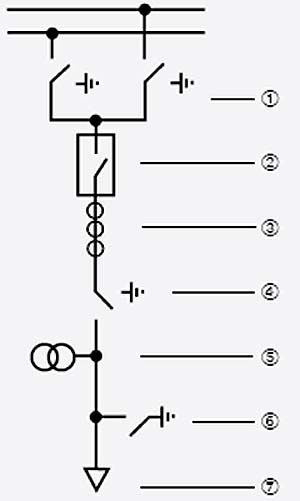
Рис. ABB
Однолинейная схема ячейки распределительного устройства с двумя системами сборных шин
( Single line of a double busbar bay)1. Disconnector and earthing switch
1. Разъединитель-заземлитель
2. Circuit breaker
2. Выключатель
3. Current transformer
3. Трансформатор тока
4. Disconnector and earthing switch
4. Разъединитель-заземлитель
5. Voltage transformer
5. Трансформатор напряжения
6. Make-proof earthing switch
6. Быстродействующий заземлитель
7. Cable end unit
7. Кабельный модуль

Рис. ABB
Ячейка распределительного устройства с элегазовой изоляцией с двумя системами сборных шинТематики
- комплектное распред. устройство (КРУ)
EN
3.3 аппарат (bay): Один или несколько трубных пучков, обслуживаемых одним или более вентиляторами, включая конструкции, воздухораспределительную камеру и другое сопутствующее оборудование.
Примечание - На рисунке 1 показано типовое расположение аппаратов.

1 - трубный пучок
Рисунок 1 - Типовое расположение аппаратов
Источник: ГОСТ Р ИСО 13706-2006: Аппараты с воздушным охлаждением. Общие технические требования оригинал документа
Англо-русский словарь нормативно-технической терминологии > bay
-
19 continuous current-carrying capacity
длительная пропускная способность по току
—
[Я.Н.Лугинский, М.С.Фези-Жилинская, Ю.С.Кабиров. Англо-русский словарь по электротехнике и электроэнергетике, Москва, 1999 г.]Тематики
- электротехника, основные понятия
EN
(длительный) допустимый ток
Максимальное значение электрического тока, который может протекать длительно по проводнику, устройству или аппарату при определенных условиях без превышения определенного значения их температуры в установившемся режиме
[ ГОСТ Р МЭК 60050-826-2009]
Этот ток обозначают IZ
[ ГОСТ Р 50571. 1-2009 ( МЭК 60364-1: 2005)]EN
(continuous) current-carrying capacity
ampacity (US)
maximum value of electric current which can be carried continuously by a conductor, a device or an apparatus, under specified conditions without its steady-state temperature exceeding a specified value
[IEV number 826-11-13]
ampacity
The current in amperes that a conductor can carry continuously under the conditions of use without exceeding its temperature rating.
[National Electrical Cod]FR
courant (permanent) admissible, m
valeur maximale du courant électrique qui peut parcourir en permanence, un conducteur, un dispositif ou un appareil, sans que sa température de régime permanent, dans des conditions données, soit supérieure à la valeur spécifiée
[IEV number 826-11-13]Ampacity, the term is defined as the maximum amount of current a cable can carry before sustaining immediate or progressive deterioration. Also described as current rating or current-carrying capacity, is the RMS electric current which a device can continuously carry while remaining within its temperature rating. The ampacity of a cable depends on:
- its insulation temperature rating;
- conductor electrical properties for current;
- frequency, in the case of alternating currents;
- ability to dissipate heat, which depends on cable geometry and its surroundings;
- ambient temperature.
Electric wires have some resistance, and electric current flowing through them causes voltage drop and power dissipation, which heats the cable. Copper or aluminum can conduct a large amount of current before melting, but long before the conductors melt, their insulation would be damaged by the heat.
The ampacity for a power cable is thus based on physical and electrical properties of the material & construction of the conductor and of its insulation, ambient temperature, and environmental conditions adjacent to the cable. Having a large overall surface area may dissipate heat well if the environment can absorb the heat.
In a long run of cable, different conditions govern, and installation regulations normally specify that the most severe condition along the run governs the cable's rating. Cables run in wet or oily locations may carry a lower temperature rating than in a dry installation. Derating is necessary for multiple circuits in close proximity. When multiple cables are near, each contributes heat to the others and diminishes the amount of cooling air that can flow past the individual cables. The overall ampacity of the insulated conductors in a bundle of more than 3 must be derated, whether in a raceway or cable. Usually the de-rating factor is tabulated in a nation's wiring regulations.
Depending on the type of insulating material, common maximum allowable temperatures at the surface of the conductor are 60, 75 and 90 degrees Celsius, often with an ambient air temperature of 30°C. In the U.S., 105°C is allowed with ambient of 40°C, for larger power cables, especially those operating at more than 2 kV. Likewise, specific insulations are rated 150, 200 or 250°C.
The allowed current in cables generally needs to be decreased (derated) when the cable is covered with fireproofing material.
For example, the United States National Electric Code, Table 310-16, specifies that up to three 8 AWG copper wires having a common insulating material (THWN) in a raceway, cable, or direct burial has an ampacity of 50 A when the ambient air is 30°C, the conductor surface temperature allowed to be 75°C. A single insulated conductor in air has 70 A rating.
Ampacity rating is normally for continuous current, and short periods of overcurrent occur without harm in most cabling systems. The acceptable magnitude and duration of overcurrent is a more complex topic than ampacity.
When designing an electrical system, one will normally need to know the current rating for the following:- Wires
- Printed Circuit Board traces, where included
- Fuses
- Circuit breakers
- All or nearly all components used
Some devices are limited by power rating, and when this power rating occurs below their current limit, it is not necessary to know the current limit to design a system. A common example of this is lightbulb holders.
[http://en.wikipedia.org/wiki/Ampacity]
Тематики
- электротехника, основные понятия
Синонимы
EN
DE
- Dauerstrombelastbarkeit, f
- Strombelastbarkeit, f
FR
- courant admissible, m
- courant permanent admissible, m
Англо-русский словарь нормативно-технической терминологии > continuous current-carrying capacity
-
20 ampacity (US)
(длительный) допустимый ток
Максимальное значение электрического тока, который может протекать длительно по проводнику, устройству или аппарату при определенных условиях без превышения определенного значения их температуры в установившемся режиме
[ ГОСТ Р МЭК 60050-826-2009]
Этот ток обозначают IZ
[ ГОСТ Р 50571. 1-2009 ( МЭК 60364-1: 2005)]EN
(continuous) current-carrying capacity
ampacity (US)
maximum value of electric current which can be carried continuously by a conductor, a device or an apparatus, under specified conditions without its steady-state temperature exceeding a specified value
[IEV number 826-11-13]
ampacity
The current in amperes that a conductor can carry continuously under the conditions of use without exceeding its temperature rating.
[National Electrical Cod]FR
courant (permanent) admissible, m
valeur maximale du courant électrique qui peut parcourir en permanence, un conducteur, un dispositif ou un appareil, sans que sa température de régime permanent, dans des conditions données, soit supérieure à la valeur spécifiée
[IEV number 826-11-13]Ampacity, the term is defined as the maximum amount of current a cable can carry before sustaining immediate or progressive deterioration. Also described as current rating or current-carrying capacity, is the RMS electric current which a device can continuously carry while remaining within its temperature rating. The ampacity of a cable depends on:
- its insulation temperature rating;
- conductor electrical properties for current;
- frequency, in the case of alternating currents;
- ability to dissipate heat, which depends on cable geometry and its surroundings;
- ambient temperature.
Electric wires have some resistance, and electric current flowing through them causes voltage drop and power dissipation, which heats the cable. Copper or aluminum can conduct a large amount of current before melting, but long before the conductors melt, their insulation would be damaged by the heat.
The ampacity for a power cable is thus based on physical and electrical properties of the material & construction of the conductor and of its insulation, ambient temperature, and environmental conditions adjacent to the cable. Having a large overall surface area may dissipate heat well if the environment can absorb the heat.
In a long run of cable, different conditions govern, and installation regulations normally specify that the most severe condition along the run governs the cable's rating. Cables run in wet or oily locations may carry a lower temperature rating than in a dry installation. Derating is necessary for multiple circuits in close proximity. When multiple cables are near, each contributes heat to the others and diminishes the amount of cooling air that can flow past the individual cables. The overall ampacity of the insulated conductors in a bundle of more than 3 must be derated, whether in a raceway or cable. Usually the de-rating factor is tabulated in a nation's wiring regulations.
Depending on the type of insulating material, common maximum allowable temperatures at the surface of the conductor are 60, 75 and 90 degrees Celsius, often with an ambient air temperature of 30°C. In the U.S., 105°C is allowed with ambient of 40°C, for larger power cables, especially those operating at more than 2 kV. Likewise, specific insulations are rated 150, 200 or 250°C.
The allowed current in cables generally needs to be decreased (derated) when the cable is covered with fireproofing material.
For example, the United States National Electric Code, Table 310-16, specifies that up to three 8 AWG copper wires having a common insulating material (THWN) in a raceway, cable, or direct burial has an ampacity of 50 A when the ambient air is 30°C, the conductor surface temperature allowed to be 75°C. A single insulated conductor in air has 70 A rating.
Ampacity rating is normally for continuous current, and short periods of overcurrent occur without harm in most cabling systems. The acceptable magnitude and duration of overcurrent is a more complex topic than ampacity.
When designing an electrical system, one will normally need to know the current rating for the following:- Wires
- Printed Circuit Board traces, where included
- Fuses
- Circuit breakers
- All or nearly all components used
Some devices are limited by power rating, and when this power rating occurs below their current limit, it is not necessary to know the current limit to design a system. A common example of this is lightbulb holders.
[http://en.wikipedia.org/wiki/Ampacity]
Тематики
- электротехника, основные понятия
Синонимы
EN
DE
- Dauerstrombelastbarkeit, f
- Strombelastbarkeit, f
FR
- courant admissible, m
- courant permanent admissible, m
Англо-русский словарь нормативно-технической терминологии > ampacity (US)
- 1
- 2
См. также в других словарях:
Chemically defined medium — A chemically defined medium is a growth medium suitable for the in vitro cell culture of human or animal cells in which all of the chemical components are known. The term chemically defined medium was defined by Jayme and Smith (2000) as a Basal… … Wikipedia
Boolean algebras canonically defined — Boolean algebras have been formally defined variously as a kind of lattice and as a kind of ring. This article presents them more neutrally but equally formally as simply the models of the equational theory of two values, and observes the… … Wikipedia
Households Below Average Income — is an annual publication on poverty statistics in the United Kingdom. The data is based on the Family Resources Survey.Poverty is defined as having an equivalised household income below the 60% median line.Links*… … Wikipedia
Exponentiation — Exponent redirects here. For other uses, see Exponent (disambiguation). Exponentiation is a mathematical operation, written as an, involving two numbers, the base a and the exponent (or power) n. When n is a positive integer, exponentiation… … Wikipedia
Comparison of C Sharp and Java — The correct title of this article is Comparison of C# and Java. The substitution or omission of the # sign is because of technical restrictions. Programming language comparisons General comparison Basic syntax Basic instructions … Wikipedia
Laplace–Runge–Lenz vector — Throughout this article, vectors and their magnitudes are indicated by boldface and italic type, respectively; for example, left| mathbf{A} ight| = A. In classical mechanics, the Laplace–Runge–Lenz vector (or simply the LRL vector) is a vector… … Wikipedia
fluid mechanics — an applied science dealing with the basic principles of gaseous and liquid matter. Cf. fluid dynamics. [1940 45] * * * Study of the effects of forces and energy on liquids and gases. One branch of the field, hydrostatics, deals with fluids at… … Universalium
radiation measurement — ▪ technology Introduction technique for detecting the intensity and characteristics of ionizing radiation, such as alpha, beta, and gamma rays or neutrons, for the purpose of measurement. The term ionizing radiation refers to those… … Universalium
Hardy space — In complex analysis, the Hardy spaces (or Hardy classes) Hp are certain spaces of holomorphic functions on the unit disk or upper half plane. They were introduced by Frigyes Riesz (Riesz 1923), who named them after G. H. Hardy, because of the… … Wikipedia
Surreal number — In mathematics, the surreal number system is an arithmetic continuum containing the real numbers as well as infinite and infinitesimal numbers, respectively larger or smaller in absolute value than any positive real number. The surreals share… … Wikipedia
Mereology — In philosophy and mathematical logic, mereology (from the Greek μέρος, root: μερε(σ) , part and the suffix logy study, discussion, science ) treats parts and the wholes they form. Whereas set theory is founded on the membership relation between a … Wikipedia
